LLM Pipelines✦Agentic AI✦RAG Systems✦Agent-Based Modeling✦Computational Social Science✦Misinformation Research✦Power BI & DAX✦Data Engineering✦LLM Pipelines✦Agentic AI✦RAG Systems✦Agent-Based Modeling✦Computational Social Science✦Misinformation Research✦Power BI & DAX✦Data Engineering✦
01 · Experience
Where I’ve made an impact.
Roles across government, research, and industry. Open any role for the full story.
Sep 2026 – PresentAmherst, MA
Operations Analyst
UMass Amherst · Facilities
LLM automation and Power BI reporting for campus facilities operations.
Details
Developing an LLM automation layer that auto-generates operational summaries and flags anomalies, using SQL and Excel to analyze trends across 500+ records and support staffing decisions.
Maintaining data integrity across 1,000+ work orders in TMA (IWMS) by enforcing schema-level naming conventions and validation rules, cutting data entry errors by 20%.
Building Power BI dashboards with 15+ DAX measures and automating recurring reports that track response times, backlog volume, and preventive maintenance compliance.
20%fewer data entry errors
1,000+work orders governed
Jun 2026 – Oct 2026Boston, MA
Data Analytics and AI Research Intern
Mass. Dept. of Environmental Protection
RAG-based natural-language-to-SQL and Redshift → Power BI pipelines for state environmental data.
Details
Engineered a RAG-based NL-to-SQL system using a vector database of embeddings over 50+ table schemas, reducing hallucinated joins by 45% and cutting manual SQL requests by 40%.
Built an ETL pipeline from AWS Redshift into Power BI, converting 30+ SQL queries into optimized DAX with incremental refresh and query folding, cutting refresh time by 30%.
Modeled the end-to-end data workflow of BWSC's BEAR application, the statewide system for tracking spill and leak incidents, to surface actionable insights from incident data.
45%fewer hallucinated joins
40%fewer manual SQL requests
Jan 2025 – May 2025Hyderabad, India
Data Science / Analytics Intern
Indian Space Research Organisation
Hybrid recommendation system for geo-satellite data products.
Details
Cleaned and processed large-scale spatial datasets (satellite IDs, product IDs, sensors, descriptions) into structured data for analysis and modeling.
Analyzed usage patterns of 1,000+ users to design a recommendation system for geo-satellite data products, with collaborative, content-based and hybrid models that improved accuracy by 25%.
Engineered a cosine-similarity pipeline and an interactive Streamlit dashboard for recommendation performance, reducing query latency by 20% to under 2 seconds.
+25%recommendation accuracy
<2squery latency
02 · Projects
Things I’ve built.
Click any project for the full case study: architecture, results, and code.
InterestsAgent-based modelingMisinformation & information diffusionComputational social scienceLLMs for social science
Sep 2026 – PresentOngoing
How misinformation spreads in a crisis
Research Assistant · UMass Amherst
Prof. Lydia Reader · Data Analytics & Computational Social Science
Details
Designing an agent-based model (Python, Mesa) of misinformation spread through social networks in crises.
Modeling how individual decisions to believe and share, based on threshold and complex-contagion theories, add up to population-level spread.
Planning simulation experiments across network structures, validated against real misinformation events.
Reviewing literature on agent-based modeling, information diffusion, and misinformation to guide model design.
Sep 2026 – PresentOngoing
LLM event extraction for conflict research
Research Assistant · UMass Amherst
Prof. Merve Keskin · Political Science
Details
Developing an LLM-based pipeline that extracts five event fields (who, did what, to whom, where, when) from unstructured text to build structured political event data for conflict research.
Applying the pipeline to a new, unstudied text source to create an original event dataset on armed conflict.
Designing prompts and an evaluation plan to check LLM-extracted events against human-coded examples.
Jan 2024 – Dec 2024
Complex-valued Hopfield networks
Undergraduate Researcher · Mahindra University
Dr. Rama Murthy · Computer Science
+30%storage capacity over binary baseline
Details
Extended the classic Hopfield associative-memory network to the complex domain, representing each neuron as a unit-magnitude phasor instead of a binary (±1) state.
Adapted the Hebbian learning rule and the iterative retrieval update to complex arithmetic in Python (NumPy).
Increased storage capacity by about 30% over the binary baseline (~0.138N patterns) and improved retrieval accuracy on corrupted inputs by 20%, tested on 100+ patterns.
Teaching
Teaching Assistant · Fall 2026
DACSS 601: Data Science Fundamentals
UMass Amherst · Prof. Merve Keskin
Instructor · 2026
“Intro to Python” Training
MassDEP · Designed and delivered a one-hour hands-on Python session for non-technical staff in the DARWG program.
X-Ray Threat Detection with Synthetic Data Augmentation
Type
Computer Vision
Stack
PyTorch · YOLOv11 · RT-DETR
Dataset
PIDray (12 classes)
Overview
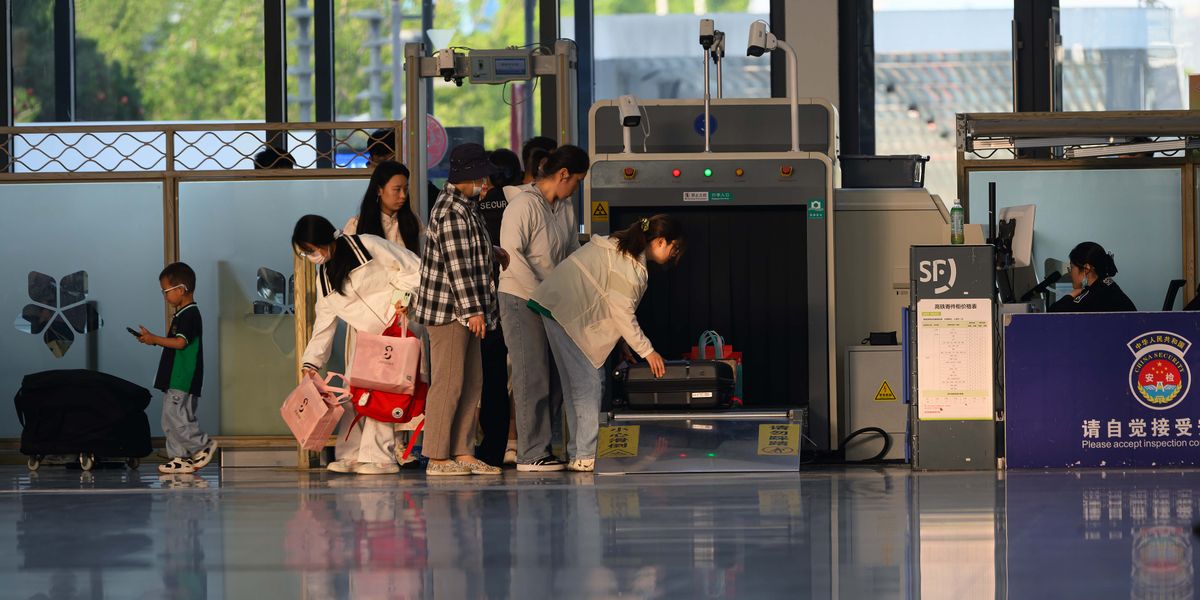
Baggage screening depends on spotting rare, dangerous items in cluttered X-ray scans. The most critical classes, like guns and bullets, are exactly the ones detectors see least during training.
This project benchmarks modern detectors and uses physics-aware and diffusion-generated synthetic data to close that gap, then serves the result as a usable triage tool.
How It Works
01
Benchmarking
Fine-tuned and compared Faster R-CNN, YOLOv11, and RT-DETR on the PIDray dataset.
02
Synthetic Augmentation
Physics-aware cut-paste plus diffusion-generated X-ray images (LoRA + ControlNet) to boost rare threat classes.
03
Open-Vocabulary Detection
Evaluated OWLv2 on threat types never seen during training.
04
Calibrated Triage & Serving
Confidence calibration to cut false alarms, with inference and demos served through FastAPI and Gradio.
Impact
92.4%
mAP@50 Target
28 ms
Per-Image Latency
20%
Fewer False Alarms
Calibrated triage holds recall at 95% while reducing false alarms, so screeners spend less time on clean bags without missing real threats. Synthetic data targets a 15% recall lift on rare threats, and OWLv2 targets 78% recall on unseen ones.
Clinical Trial Data Validation & Compliance Orchestration Platform
Type
Multi-Agent System
Stack
LangGraph · MCP · Streamlit
Domain
Clinical Data Compliance
Data
5,000 synthetic visits
Overview
A clinical trial collects thousands of patient visits from many sites, and every record has to be checked before it can be used: is it complete, is it possible, is anything medically worrying? Much of this is still done by hand. It is slow, and real problems get lost among routine records.
Most records only need fixed checks. Some, like a serious adverse event or a very unusual lab value, need a person. Others are data entry mistakes the site should fix. This platform sorts records into those three groups, explains every decision, keeps a tamper-evident audit log, and delivers cleared records to the next system without losing any.
All data is synthetic: study "CT-201" compares a made-up drug, XR-17, against placebo across 1,000 patients and 6 sites.
Architecture
Four agents are connected as a LangGraph graph: validate → detect anomalies → route → report. Agents 1–3 hold no check logic themselves; they call deterministic tools served by an MCP server over stdio, in batches of 500 records (10 calls per tool, 30 in total). Run with --local, the same functions are called directly with identical results. Every audit entry records which tool was used and whether it ran via MCP or locally.
5,000 records ─► Validate ─► Z-score ─► Route ─► Report
                    └───────────┴──────────┴──► Audit log (hash chain)

AUTO_CLEAR   ─► Submission gateway ─► outside system
HUMAN_REVIEW ─► review queue (decision also logged)
QUERY_SITE   ─► back to the site to fix
How It Works
01
Synthetic Data
5,000 visits with planted problems: missing fields, visits before consent, impossible ages and blood pressures, wrong arm codes (XR17), exact duplicates, real ALT outliers, and a hidden liver safety signal at SITE-04.
02
Agent 1 · Validate
Required fields, allowed arms, plausible ranges (age 18–90, systolic BP 70–220 mmHg, ALT 3–2000 U/L, creatinine 0.2–10 mg/dL), visit not before consent, AE grade present when an AE is reported, and duplicate detection.
03
Agent 2 · Z-score
Z-scores ALT, creatinine, and systolic BP against the mean and standard deviation of the same treatment arm. Stats come from valid records only, so bad data cannot distort them. |z| ≥ 3 is flagged as an outlier.
04
Agent 3 · Route
First matching rule wins: any data error → QUERY_SITE; serious AE, AE grade 3+ (CTCAE scale), or a lab outlier → HUMAN_REVIEW with HIGH/MEDIUM priority; everything else → AUTO_CLEAR.
05
Agent 4 · Report
Computes counts, top error types, and a per-site safety signal (share of XR-17 visits with ALT z ≥ 3, then z-scored across sites). A local Llama 3.2 model via Ollama writes the summary from those facts only; a fixed template is the fallback.
06
Audit Log
Append-only SQLite log storing record, agent, decision, reason, rule version, and timestamp, each chained to the previous entry with a SHA-256 hash. verify() pinpoints the first altered entry. Entries can also be streamed to a Kafka topic.
07
Submission Gateway
Sends cleared records to a simulated outside system (8% random errors, 20 calls/s limit, a 30-second outage) through a token-bucket rate limiter, exponential backoff with jitter, a circuit breaker (opens after 5 consecutive failures, 30 s cooldown), and a dead-letter queue.
Results
94.2%
Auto-Cleared
758 → 0
Failed Submissions
15,827
Verified Audit Entries
The seed is fixed, so every run produces the same numbers.
Routing
Decision
Records
Share
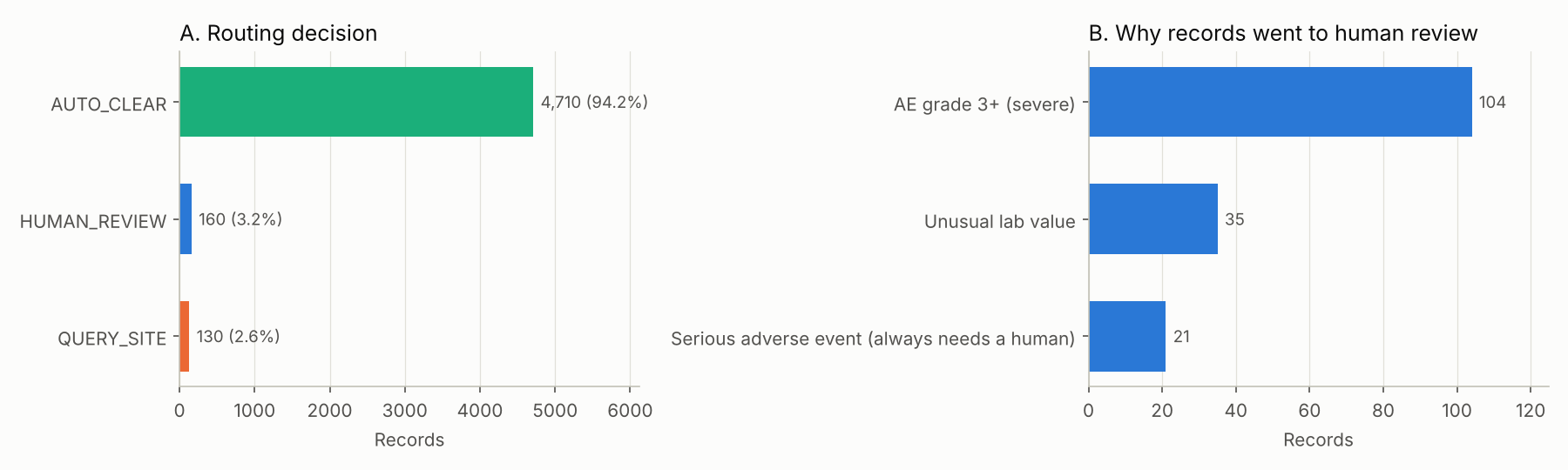
AUTO_CLEAR
4,710
94.2%
HUMAN_REVIEW
160
3.2%
QUERY_SITE
130
2.6%
Routing decisions and human review reasons
Top data errors sent back to sites
Error
Records
Visit date before consent date
25
Unknown arm
20
Duplicate record
20
Missing visit date
16
Impossible age
15
Missing arm
12
Site safety signal
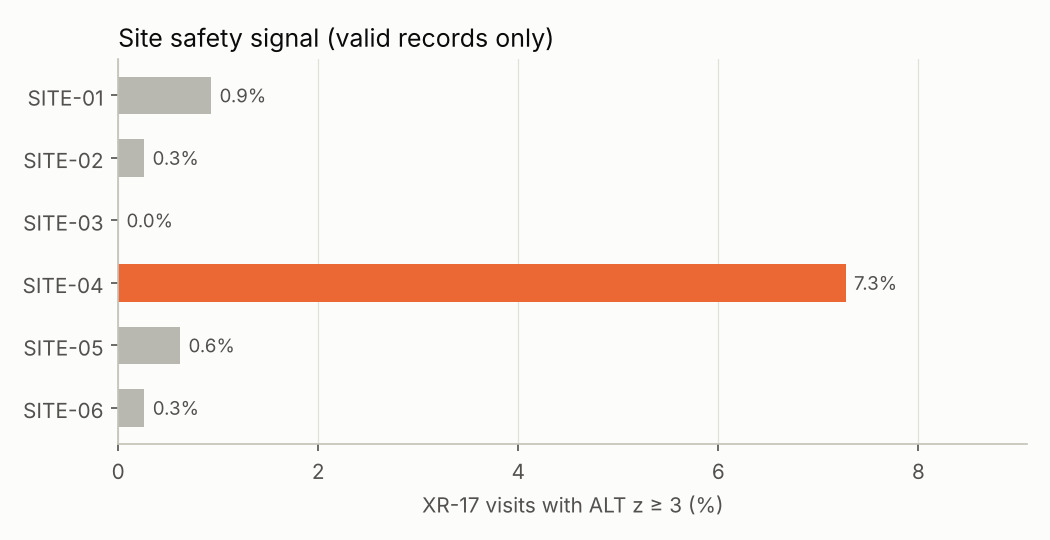
SITE-04 shows ALT outliers in 7.3% of XR-17 visits (site z = 2.03); every other site is under 1%.
Site
% ALT outliers
Site z
SITE-01
0.9%
−0.22
SITE-02
0.3%
−0.46
SITE-03
0.0%
−0.55
SITE-04
7.3%
2.03
SITE-05
0.6%
−0.33
SITE-06
0.3%
−0.46
ALT outliers by site
Submission reliability
Client
Failed
Failed %
API calls
Send once
758
16.1%
4,710
Retry 3× right away
99
2.1%
5,422
Gateway, first pass
1
0.0%
—
Gateway + dead-letter retry
0
0.0%
5,220
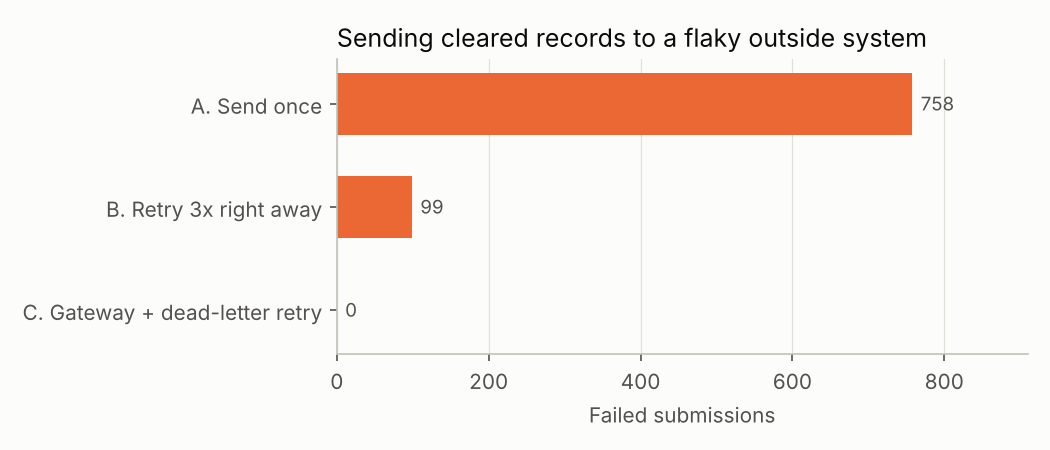
Failed submissions by client
Submission numbers come from a simulated outside system, with the same seed for every client so the comparison is fair. The audit log holds 14,871 entries after the pipeline and 15,827 after submission, and the hash chain verifies; editing any single entry is detected.
Review App
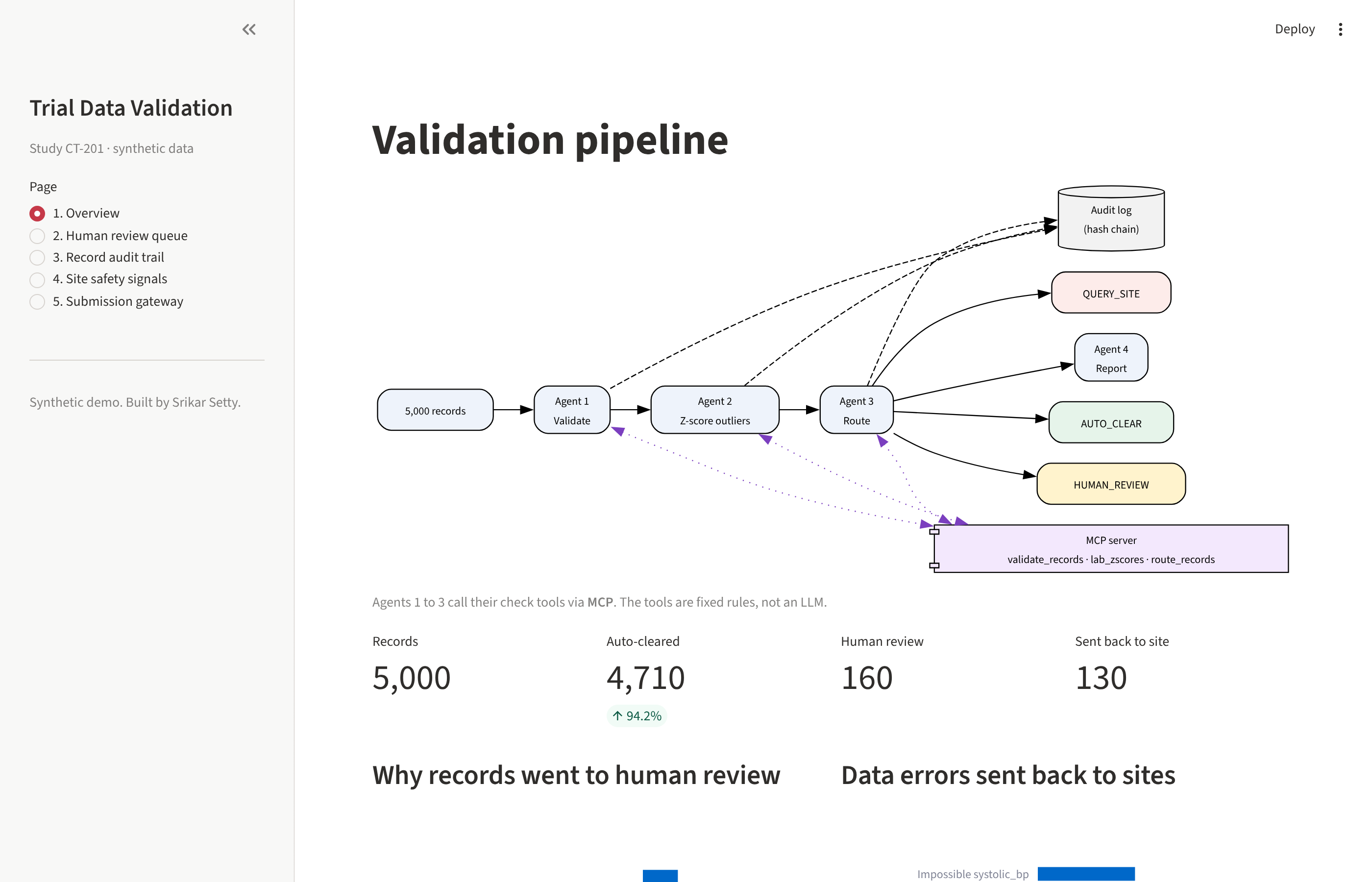
A five-page Streamlit app reads the results database:
Overview: pipeline diagram, routing counts, review reasons, and data errors.
Human review queue: high-risk records; every reviewer decision requires a comment and is written to the audit log.
Record audit trail: every entry for one record, plus a one-click check of the whole hash chain.
Site safety signals: ALT outlier share and ALT values by site.
Submission gateway: send once vs. immediate retry vs. gateway against the same flaky system.
Streamlit app, overview page
Design Choices
Rules decide, the LLM only writes. Safety decisions must be predictable and explainable.
Bad data is never dropped. It goes back to the site with the reason.
Z-score stats come from valid records only, so errors cannot distort them.
Every decision stores the rule version, so you always know which rules made it.
Tools sit behind a standard interface. Agents don’t know whether they call MCP or local functions.
Limitations
All data is synthetic, and the planted errors are simpler than real ones.
Rule thresholds (ranges, z ≥ 3, grade 3+) are for demonstration, not from a real protocol.
The outside system is simulated; real systems fail in other ways too.
The audit log is tamper-evident, not tamper-proof: it shows that an entry changed, not who changed it.
Older people with dementia who walk away from home often don’t know they’re lost. They don’t call for help or answer when searchers shout their name; they just keep walking. In Koester’s dementia incident data (ISRID), most keep going in one direction until something stops them, and 95% of those found within 24 hours were alive, versus 77% found later. Yet searches often still start with a circle around the house.
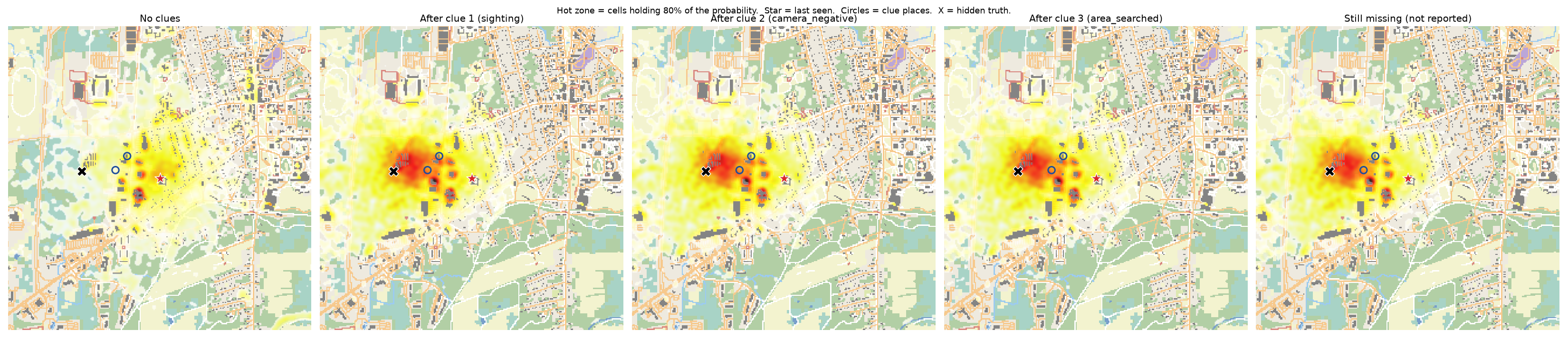
Sim2Find turns that research, plus whatever clues come in, into a map that tells a team where to look first. Given where and when the person was last seen, it simulates thousands of possible walks on the real Amherst terrain and returns a heat map, not a pin: red areas are where most walks ended.
As clues arrive, the map updates. A sighting pulls the heat toward that place; a camera that saw nothing or an area already searched cools those spots. Witness reports can be typed in plain words and an LLM drafts a structured clue, but a person always confirms it. The walking itself is done by the agent-based model, never the LLM.
Heat Map Before and After Clues
Heat map before and after clues
How It Works
01
Terrain Grid
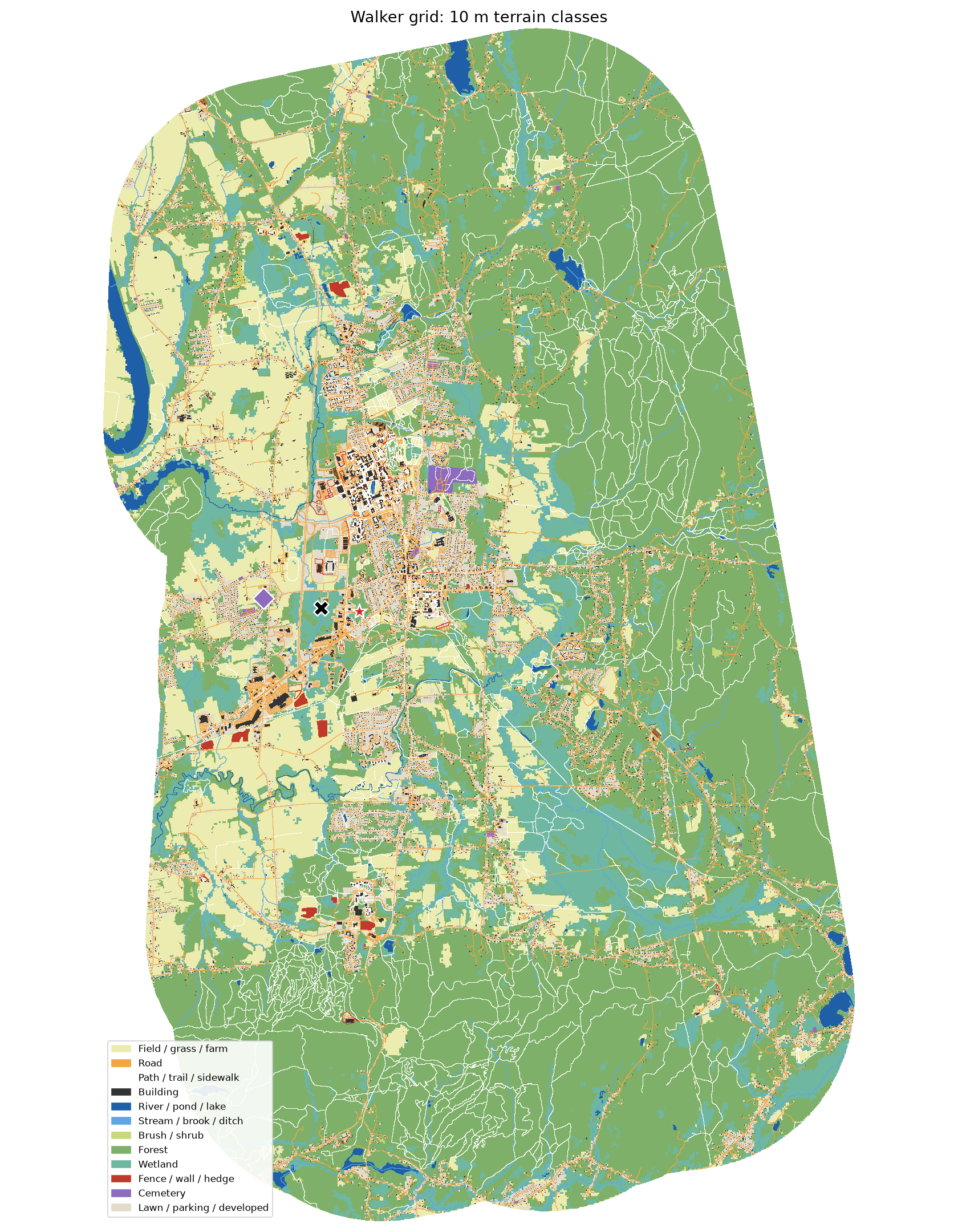
Real Amherst terrain on a 10 m grid built from OpenStreetMap, USGS 3DEP elevation, and NLCD 2021 land cover, with road traffic levels, buildings, fences, woods, wetland, streams, and low ground.
02
Agent-Based Walkers
Each walker follows rules from Koester’s lost-person research on dementia: most go straight until stuck, 66% cross roads instead of following them, they tend to go downhill, can stop at buildings, water, or rough terrain, and can be spotted by the public on busy roads.
03
Calibration
22 rule numbers tuned with Bayesian optimization (Optuna TPE, 400 settings over 20 start points) until walkers match 16 ISRID statistics on distance, find location, and elevation change. Every rule is labeled DATA, EXPERT, or ASSUMPTION.
04
Clue Inference
Clues reweight walkers like a particle filter. A sighting also restarts 10,000 new walkers from the sighting place; camera negatives and searched areas cool their cells; “still missing” down-weights walkers that spent time on busy roads.
05
Heat Map
Probability per grid cell at any chosen minute. 5% of the map always falls back to distance rings around the latest known place, so no area is ever zero. The UI shows the hottest cells holding 80% of the probability and the top three priority areas.
06
LLM Clue Extraction
Free-text witness reports are converted into draft clues (Gemini, with Claude as an alternative), with reliability set to high, medium, or low. A guided chat asks for missing coordinates, times, or radius, and nothing updates the map until a person accepts it.
Amherst model grid
Results
56%
Less Ground Searched (Sighting)
83%
Cases Won vs. Circle Search
9.9 → 3.8
Calibration Error
Benchmark: 999 held-out cases
True locations are placed only from ISRID statistics, never by the model’s own walkers. Score = area searched before reaching the person, most likely cells first.
Circle search
Sim2Find
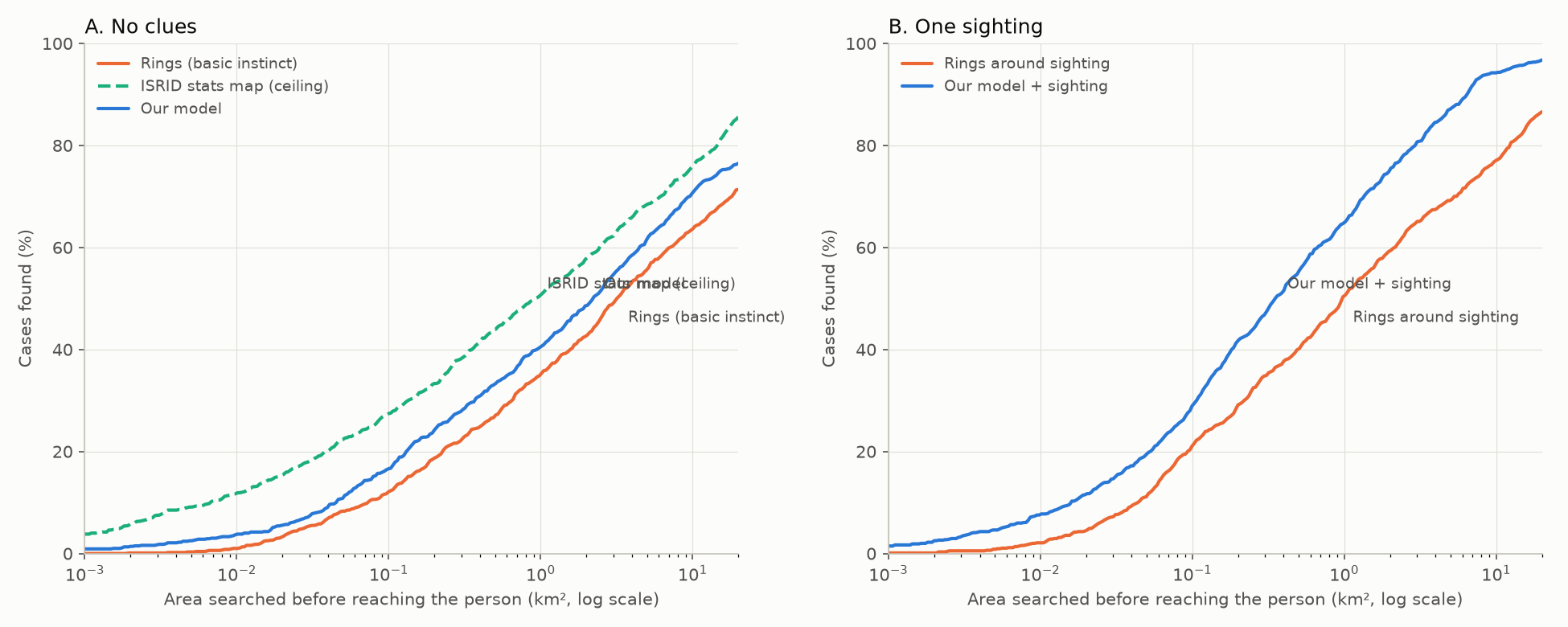
One sighting: total ground searched
6,611 km²
2,928 km² (56% less)
One sighting: cases won (excluding ties)
—
83%
One sighting: median area per case
0.97 km²
0.35 km² (2.7× less)
One sighting, person > 3 km away (median)
20.1 km²
4.4 km²
No clues: total ground searched
23,126 km²
19,381 km² (16% less)
Sim2Find vs. circle search
Found within a given search area (one sighting)
Method
0.25 km²
0.5 km²
1 km²
2 km²
Rings around the sighting
32%
40%
50%
59%
Sim2Find, restart from sighting
44%
55%
65%
75%
Calibration against ISRID
The error score across 16 ISRID statistics fell from 9.91 with default rules to 3.83. Find distances now match closely, and road and structure finds line up with the data.
Statistic
ISRID
Before
After
Distance 25th percentile
0.3 km
0.2 km
0.4 km
Distance median
1.0 km
0.4 km
1.0 km
Distance 75th percentile
2.4 km
0.8 km
2.5 km
Found on road
18%
6.3%
18.7%
Found at structure
20%
26.6%
18.9%
Sensitivity analysis
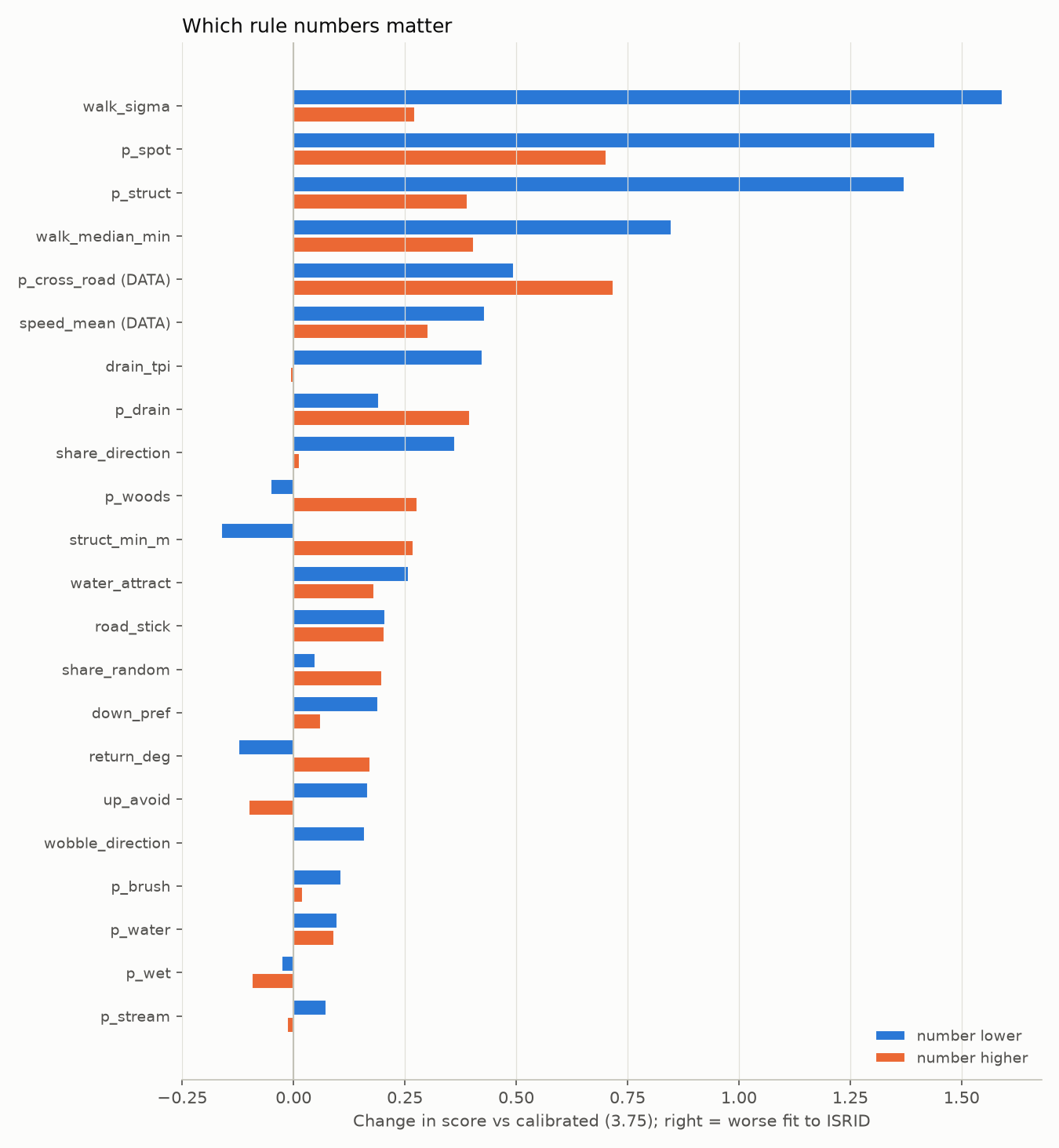
Each rule number was changed by ±50% (DATA values ±20%). Only 3 of 22 numbers move the fit much (walking-time spread, public spotting rate, stopping at buildings), and each is pinned by its own ISRID statistic.
Which rule numbers matter
Web App
Case setup: last-seen point and time, estimate-as-of time (up to four hours later), optional departure direction and goal place.
Live heat map over OpenStreetMap tiles with a time slider, top-three priority areas, and nearby named features.
Clue workflow: sightings, camera negatives, and searched areas pinned on the map, with editable reliability, miss rate, detection, and radius; clues can be edited or removed and weights recompute.
Deployment: lightweight Python server (NumPy + Pillow) on Render at sim2find.us, with pre-baked terrain tiles and a cached demo run of 5,000 walkers.
Limitations
The demo case (Walter) is fictional.
Benchmark cases are built from published ISRID statistics, not real case records.
The map’s probabilities are model estimates, not validated for real search decisions.
The next-best-check suggestion is not implemented yet. Next step: test against real solved cases with a search team.
MedBot: Fine-Tuned Medical Chat Assistant with RAG
Institution
Mahindra University
Timeline
Jan 2024 – Jun 2024
Model
Mistral 7B v0.3 (4-bit, LoRA)
Data
HealthCareMagic · MedQuAD
Overview
People often describe their symptoms online before seeing a doctor. General-purpose language models can answer, but they don’t sound like a doctor, rarely say when to get care in person, and don’t show where their facts come from.
MedBot is a small, open model that replies the way a doctor would on a health Q&A site: what the problem may be, what to do next, and when to see someone in person. With RAG turned on, it also retrieves the closest passages from NIH health documents (MedQuAD) and lists their source links under the answer.
Mistral 7B is loaded in 4-bit and fine-tuned with LoRA on real doctor answers from HealthCareMagic. The whole pipeline runs in one Colab notebook on a free T4 GPU in about 1 to 1.5 hours.
Educational project, not medical advice.
How It Works
01
Cleaning
HealthCareMagic answers are full of politeness ("Hi, thanks for your query", "I understand your concern", "Regards, Dr. X"). A regex-based cleaner fixes glued sentences (e.g. "LIVERHi", "advice.As") and strips greetings, thank-yous, sign-offs, and doctor names so the model learns the medical content.
02
Noise Filtering
Each pair is dropped for the first rule it fails, with the reason recorded: answer under 25 words, contact details or self-promotion, duplicate question, greeting-only answer, over 600 words (too long for 1,024 tokens), question under 5 words, or garbled text.
03
Held-out Split
Cleaned pairs are shuffled once with a fixed seed. 100 questions are held out as a test set and never trained on (an assertion guards against leakage); 5,000 pairs are used for training.
04
Prompt Format
One prompt template for both training and testing, with Instruction, optional NIH Reference, Patient, and Doctor sections. An end-of-sequence token is appended to each training example so the model learns to stop.
05
Fine-tuning
Mistral 7B v0.3 in 4-bit with LoRA (r = 16, α = 16) on all attention and MLP projections, about 0.6% of parameters trainable. 1 epoch, learning rate 2e-4, cosine schedule, 8-bit AdamW, using Unsloth and TRL.
06
RAG
MedQuAD answers are cut into ~150-word chunks with 30-word overlap, each keeping its source URL, and embedded with all-MiniLM-L6-v2. For each question, the 3 closest chunks by cosine similarity are added to the prompt and cited under the answer.
07
Evaluation
Base model vs. fine-tuned vs. fine-tuned + RAG on the same 100 held-out questions, scored against the real doctor’s answer with ROUGE-L and BERTScore F1.
Results
226,405
Dialogs Cleaned
9.4%
Low-Quality Pairs Removed
12%
Boilerplate Words Stripped
Data cleaning (full dataset)
Count
Conversations
226,405
Kept
205,140
Removed
21,265 (9.4%)
Boilerplate words stripped from kept answers
12.0%
Removal reasons
Reason
Count
Answer too short (< 25 words after cleaning)
12,617
Contact details or self-promotion
7,154
Duplicate question
538
Answer was only greetings or sign-off
459
Too long for the 1,024-token limit (> 600 words)
443
Question too short (< 5 words)
53
Could not parse
1
Before and after cleaning
BeforeFATTY LIVERHi and welcome to Healthcaremagic. Thank you for your query. I am Dr. Rommstein, I understand your concerns… Kindly regards. Wish you a good health. DR. Ivan Rommstein
AfterFATTY LIVER. This is possible fatty liver. It can help to avoid drinking…
Model evaluation
The notebook compares the three models on 100 held-out questions and writes the scores to results.json and side-by-side answers to examples.csv. Because the reference is the real doctor’s answer, the scores measure closeness to that doctor; RAG adds NIH facts the doctor may not have written, so its score can drop even when the answer is better grounded.
v1 → v2
v1
v2
Only removed extra spaces and cut at "Regards"
Fixes glued sentences; removes greetings, thank-yous, sign-offs, and doctor names
Kept every record
Drops low-quality pairs, with a reason for each
Trained on train + test + validation together
100 test questions held out, never trained on
30 steps (~240 examples)
1 full epoch over 5,000 examples
No end token
EOS added so the model learns to stop
No evaluation
Base vs. fine-tuned vs. fine-tuned + RAG on ROUGE-L and BERTScore
No RAG
RAG over MedQuAD (NIH) with source URLs
Engineering
GPU-free, tested helpers. Parsing, cleaning, filtering, splitting, prompting, chunking, retrieval, and ROUGE-L live in one plain-Python module with unit tests.
Single source of truth. A build script generates the Colab notebook from the tested module, so notebook and code never drift.
Reproducible. Fixed seeds throughout; the notebook saves the LoRA adapter, results, examples, cleaning report, test set, and training log as one zip.
Try it. An ask_medbot() helper answers any question with or without RAG and prints its NIH sources.
Limitations
HealthCareMagic answers come from online doctors of varying quality; the model learns their style and their mistakes.
ROUGE-L and BERTScore measure similarity to one doctor’s answer, not medical correctness. No clinician has reviewed the outputs yet.
The test set is 100 questions, so small score differences are not meaningful.
RAG only covers topics in MedQuAD, and the retriever can return a related but wrong topic.
Next step: have clinicians rate a sample of answers for correctness and safety.
Technologies Used
PythonPyTorchMistral 7BUnslothTRLPEFT / LoRA4-bit QuantizationHugging Face DatasetsSentence-Transformersall-MiniLM-L6-v2RAGROUGE-LBERTScoreGoogle Colab (T4)


 PyTorch
 Hugging Face
 LangChain
 LangGraph
 MCP
 RAG
 YOLO
 Scikit-learn
 Python
 SQL
 R
 Pandas
 PySpark
 PostgreSQL
 Snowflake
 AWS
 BigQuery
 Kafka
 Power BI
 Tableau
 Streamlit
 Mesa (ABM)